
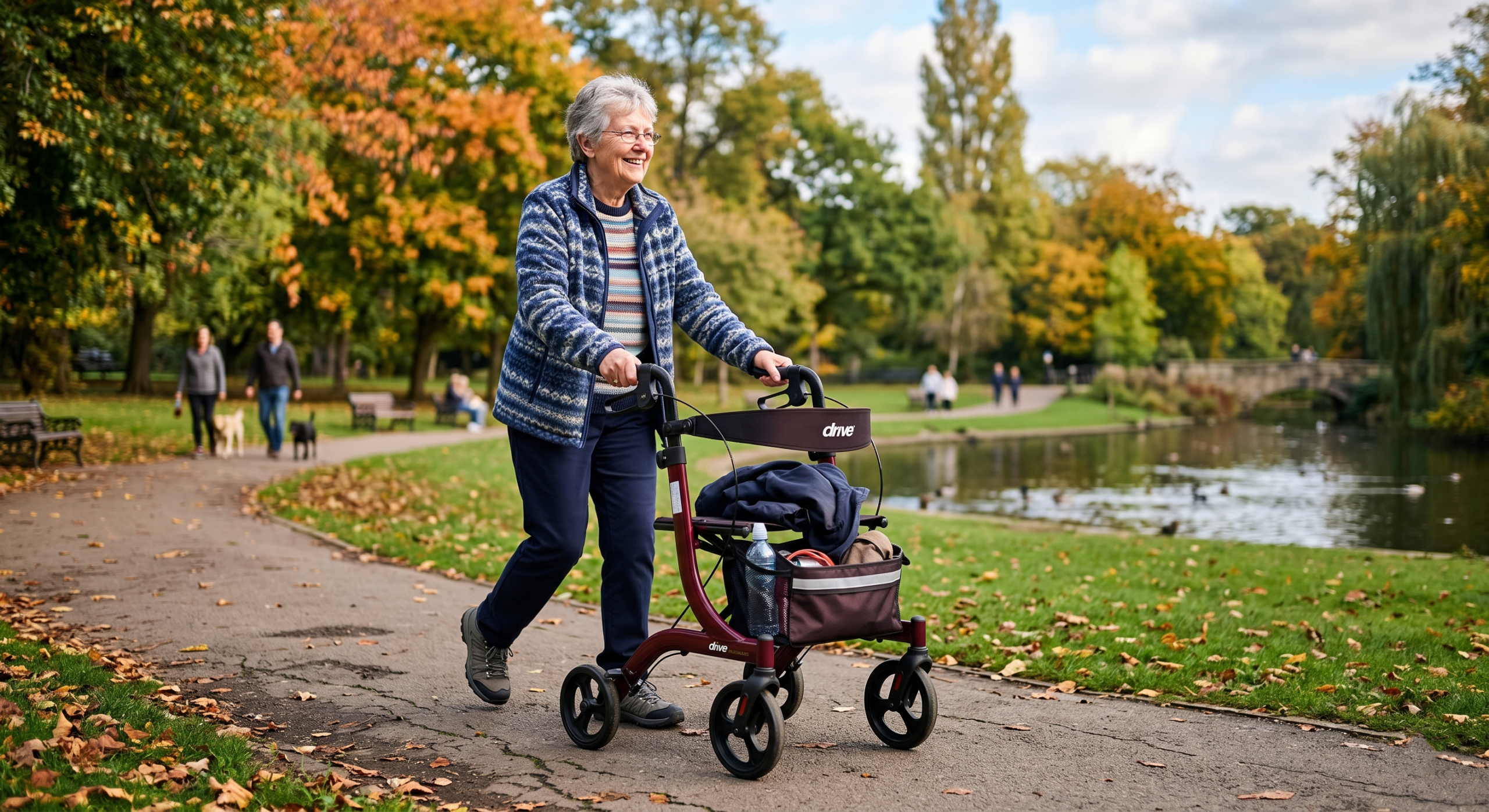
Rollator walkers have become the most popular mobility aid for active seniors. Unlike standard walkers that must be lifted with every step, rollators move smoothly on four wheels and include built-in seats, making them ideal for seniors who want to stay active while having reliable balance support.
But not all rollators are equal. Choosing the wrong one can mean a walker that is too heavy, too wide, too unstable, or missing the features that matter most for the individual senior’s needs.
This guide covers everything to look for when choosing a rollator walker for a senior.
A Note From Margaret Collins
Choosing a rollator is one of the decisions I get asked about most frequently by families. The most common mistake I see is choosing based on price alone — buying the cheapest option and ending up with a rollator that is too heavy, has unreliable brakes, or folds in a way the senior cannot manage independently. A good rollator genuinely extends a senior’s active life. A poor one ends up in the corner unused. This guide covers what actually matters when making this choice.
What Is a Rollator Walker?
A rollator is a four-wheeled walking frame with hand brakes, a built-in seat, and usually a storage basket or bag underneath. The senior pushes the rollator forward while walking, using the handles for balance support, and can sit on the seat to rest at any point.
Rollators are different from standard walkers in one critical way — they are designed for seniors who can walk independently but need balance support, not for seniors who need to bear significant weight through their arms. A senior who needs to lean heavily on their walker for support may be better suited to a standard two-wheel walker.
Who Is a Rollator Best For?
A rollator is the right choice for seniors who:
- Can walk independently but have mild to moderate balance issues
- Walk longer distances and need the ability to rest
- Are active and want to maintain their lifestyle
- Use public transport, go shopping, or attend social activities
- Find standard walkers too slow or tiring to use
A rollator is not the right choice for seniors who:
- Need to bear significant weight through their arms
- Have severe balance issues requiring maximum stability
- Are in the early stages of post-surgery recovery requiring a stable lift walker
Key Features to Look for in a Rollator
1. Weight of the Rollator
The weight of the rollator itself matters significantly. A senior must be able to lift it into a car boot, carry it up a step, or maneuver it through a tight space.
Lightweight rollators — 12 to 15 lbs. Ideal for seniors who travel, use public transport, or have limited upper body strength.
Standard rollators — 15 to 20 lbs. Suitable for most home and community use.
Heavy duty or bariatric rollators — 20 lbs and above. Required for seniors who exceed standard weight limits.
Always consider how the senior will transport the rollator. If it goes in a car regularly, lighter is almost always better.
2. Weight Capacity
Every rollator has a maximum weight capacity. Standard rollators support up to 250 to 300 lbs. If the senior exceeds this, a bariatric rollator rated for higher weights is essential.
Never use a rollator that is not rated for the senior’s weight. The frame can bend or collapse under excess load.
Recommended option: For seniors who need a lightweight option, the Medline Freedom Lightweight Rollator weighs under 13 lbs and is one of the easiest rollators to lift into a car independently.
3. Wheel Size
Wheel size determines how well the rollator handles different surfaces.
Small wheels (6 inches) — Suitable for smooth indoor surfaces. Less effective on uneven outdoor terrain.
Medium wheels (7 to 8 inches) — Good all-round performance for both indoor and outdoor use. The most common choice.
Large wheels (10 inches and above) — Best for outdoor use on grass, gravel, or uneven surfaces. Heavier and wider than smaller-wheeled models.
For seniors who use their rollator primarily indoors, smaller wheels are fine. For seniors who are active outdoors, larger wheels provide significantly smoother movement.
4. Brake Quality and Type
Brakes are the most critical safety feature on a rollator. There are two main types:
Loop brakes — Squeezing the brake handles slows the rollator. Releasing the brakes allows it to roll freely. This is the standard rollator brake type and suitable for most seniors.
Push-down brakes — Pushing down on the handles activates the brakes. This type can be easier for seniors with weak hand grip who struggle to squeeze loop brakes.
Whatever the type, brakes must lock firmly when engaged for sitting. Test this before purchasing — sit on the seat with the brakes locked and the rollator should not move at all.
Avoid rollators with brakes that feel soft, spongy, or unreliable. Brakes that fail to hold are a serious fall risk.
Recommended option: The Drive Medical Nitro Euro Style Rollator consistently receives high marks for brake reliability and is one of the most recommended rollators by physical therapists for active seniors.
5. Seat Height and Comfort
The built-in seat allows seniors to rest without needing to find a chair. For this to be useful and safe, the seat must be at the correct height.
Correct seat height: When the senior sits on the rollator seat, their feet should be flat on the floor and their knees at approximately 90 degrees.
Most rollators have adjustable seat heights. Check the adjustment range before purchasing to ensure it covers the senior’s needs.
Seat width also matters. Standard rollator seats are 10 to 12 inches wide. Wider seats are available for greater comfort.
6. Handle Height Adjustment
Handle height must be adjustable to suit the senior’s height. Correct handle height: when standing upright holding the handles, the senior’s elbows should be slightly bent at approximately 15 to 20 degrees.
Handles that are too low cause hunching. Handles that are too high cause shoulder strain. Always adjust before first use and check periodically.
7. Folding Mechanism
Most rollators fold for storage and transport. The folding mechanism should be simple enough for the senior to operate independently.
Test the folding mechanism before purchasing. A rollator that is difficult to fold will simply not get folded — which means it will not fit in the car and will not be used for outings.
8. Storage Options
Most rollators include a basket or bag under the seat. This is practical for carrying shopping, a handbag, medication, water, or any items the senior needs during the day.
Consider how much storage the senior typically needs. Some rollators have larger baskets or additional pouches on the sides.
9. Width of the Rollator
Rollator width determines whether it can navigate through doorways and tight spaces in the home and in public buildings.
Standard rollator width: 24 to 26 inches. Most doorways in modern homes are 32 inches or wider, so standard rollators fit easily.
Narrow rollators: 22 to 23 inches wide. Better for older homes with narrower doorways.
Always measure the narrowest doorways in the senior’s home before purchasing.
Indoor vs Outdoor Rollators
Some rollators are designed primarily for indoor use and others for outdoor use. Many are suitable for both.
Indoor rollators — Lighter, narrower, smaller wheels. Easier to maneuver in tight spaces. Less effective on uneven outdoor surfaces.
Outdoor rollators — Larger wheels, wider frame, more robust construction. Handle outdoor terrain well but can feel bulky indoors.
All-terrain rollators — Designed for rough outdoor surfaces including grass, gravel, and slopes. Heaviest option but most versatile for active outdoor seniors.
For most seniors, an all-round rollator with medium wheels handles both indoor and outdoor use well enough for daily life.
Three-Wheel vs Four-Wheel Rollators
Three-wheel rollators are narrower and lighter than four-wheel models, making them easier to maneuver in tight spaces. However, they do not have a seat and are less stable than four-wheel rollators.
Four-wheel rollators provide more stability, include a seat, and are better suited to most seniors. Three-wheel models are best for seniors with good balance who need only light support in tight spaces.
Safety Tips for Using a Rollator
Always engage the brakes before sitting — Never sit on the rollator seat without locking the brakes first. An unlocked rollator will roll away.
Do not lean over the front — Keep the body upright and the rollator close. Leaning forward shifts weight onto the rollator and reduces stability.
Use the brakes on slopes — Apply the brakes when walking downhill to control speed. Never let the rollator roll freely on a slope.
Check the rollator regularly — Inspect wheels, brakes, and the folding mechanism monthly. Replace worn parts immediately.
Replace worn rubber ferrules — The rubber tips on the rear legs of some rollators wear down. Check and replace when needed.
Frequently Asked Questions
What is the difference between a walker and a rollator? A walker typically has no wheels or only front wheels and must be lifted or glided. A rollator has four wheels with brakes and a built-in seat. Rollators move more smoothly and are better for active seniors.
Are rollators safe for seniors with balance problems? Rollators are suitable for seniors with mild to moderate balance issues. Seniors with severe balance problems or those who need to bear significant weight through their arms are safer with a standard walker.
How heavy should a rollator be? For most seniors, a rollator between 12 and 18 lbs is ideal. Lighter rollators are easier to transport and maneuver but may feel less substantial. Heavier rollators are more robust but harder to lift.
Can a rollator be used on carpet? Yes, but carpet creates more resistance than smooth floors. Larger wheels handle carpet better than small wheels. Some seniors find rollators harder to push on thick carpet.
How do I know if a rollator is the right height? When standing upright holding the handles, the elbows should be slightly bent at 15 to 20 degrees. Adjust the handle height until this position is comfortable.
Do rollators fold flat? Most rollators fold for storage and transport. The folding mechanism varies by model. Always test the folding mechanism before purchasing to ensure it is simple enough for the senior to operate.
According to a study published in the Journal of Aging Research, seniors who use correctly fitted rollators show significantly improved walking confidence and cover greater daily distances than those using standard walkers, supporting long-term mobility and independence.
Conclusion
A rollator walker can significantly improve a senior’s quality of life by providing reliable balance support while allowing natural, comfortable movement. Choosing the right rollator means considering weight, wheel size, brake quality, seat height, handle adjustment, and width — all matched to the senior’s specific needs and lifestyle.
Take time to try different models before purchasing. The right rollator feels stable, comfortable, and confidence-inspiring from the first use. For active seniors who want to stay mobile and independent, a quality rollator is one of the best investments in daily safety and wellbeing.
2 thoughts on “Best Rollator Walkers for Seniors: What to Look For”
Comments are closed.