
Home Safety
How to Make Stairs Safe for Elderly: Complete Guide
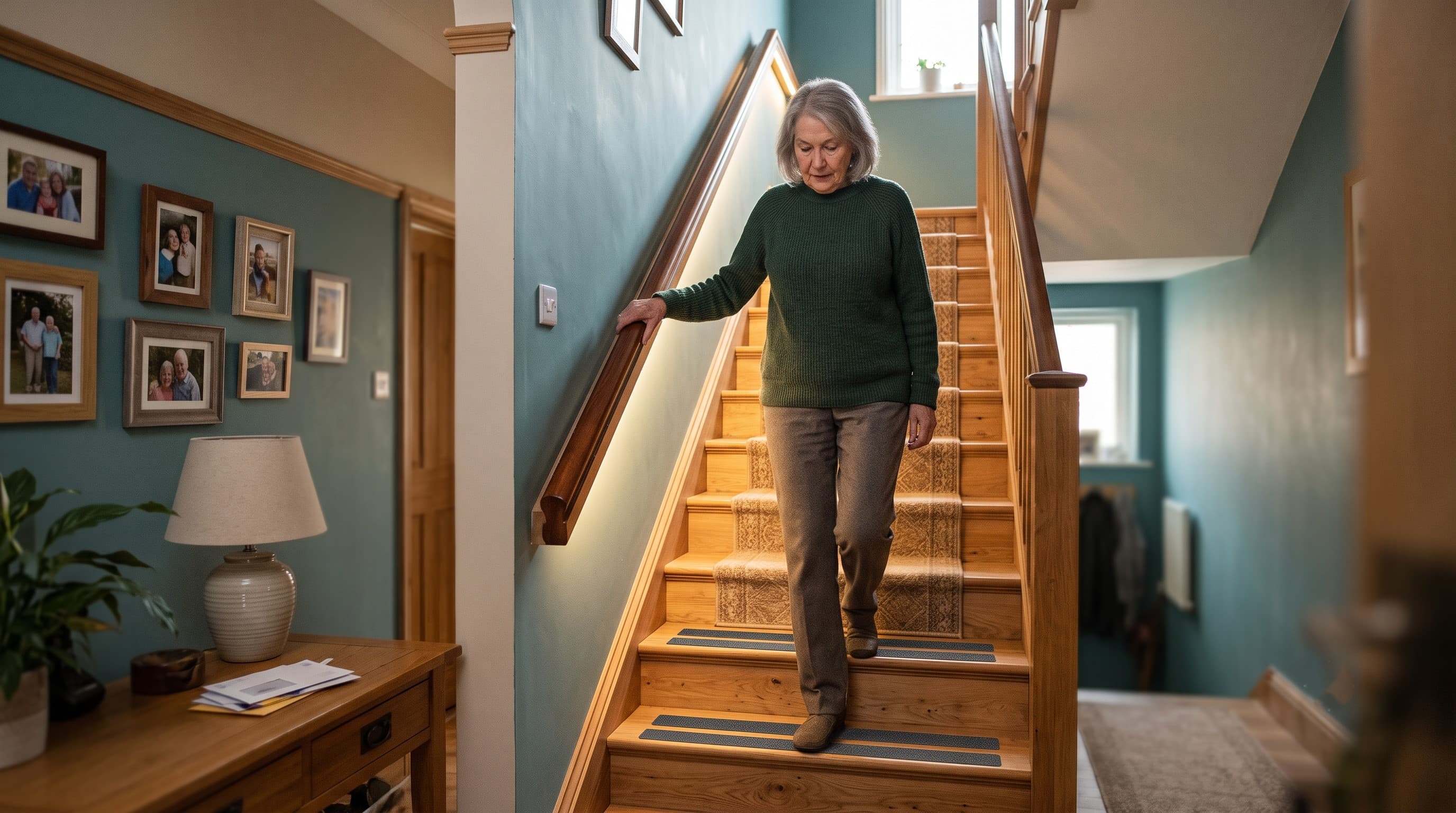
Stairs combine several fall-risk factors that don't occur together anywhere else in the home, which is why they deserve dedicated attention beyond general home safety fixes. This guide walks through what actually reduces stair risk, in order of impact. It is written for adult children, spouses, and caregivers who want clear recommendations without sales pressure or medical jargon. For the rest of the home, our whole-house fall prevention guide covers the other high-risk routes.
Some links may be affiliate links. We may earn a commission at no extra cost to you. See our affiliate disclosure.
Why stairs are uniquely risky
A fall on level ground is concerning; a fall on stairs adds the risk of a longer, more forceful tumble across multiple steps, which is why stair falls are disproportionately associated with serious injury compared to falls on flat surfaces. Stairs also combine several demands at once: judging step depth and height accurately, maintaining balance while the body's center of gravity shifts differently than on flat ground, and often doing this while carrying something (laundry, groceries) that reduces the ability to use a handrail.
This combination of factors means stairs deserve to be treated as a distinct fall-risk zone requiring their own dedicated safety pass, not just a general application of whole-house fixes.
Handrails that actually help
A secure handrail running the full length of the staircase — not stopping partway, and not just present on one side when both would help — provides continuous support through the entire climb or descent, including the often-overlooked top and bottom steps where many stair falls actually occur. The handrail should be graspable (round or oval profile that a hand can wrap fully around, roughly 1.25-1.5 inches in diameter) rather than a flat decorative rail that's harder to grip firmly.
For a wider or steeper staircase, handrails on both sides provide meaningfully more support than a single rail, since they allow a secure two-handed grip during the most demanding sections rather than relying on one side alone.
Lighting and contrast
Stairs need strong, even lighting at both the top and bottom, with a switch accessible from either end so the stairs are never navigated by feel in partial darkness. Shadows across steps can hide the actual edge of a tread, making depth perception harder exactly where accuracy matters most — a light source positioned to minimize shadow across the stair surface itself, not just general room lighting nearby, addresses this directly. Our lighting mistakes guide covers this exact gap in more detail.
Visual contrast between each step's edge and the rest of the tread — through contrasting paint, a strip of contrasting tape, or simply good lighting that reveals the edge clearly — helps compensate for reduced depth perception, which is common with age-related vision changes and makes uniform, single-color stairs genuinely harder to navigate safely than they might appear.
Treads, nosings, and clutter
Worn, torn, or loose carpet on stairs is a significant and often underestimated hazard, since a single unstable step undermines the safety of the entire staircase regardless of how well everything else is set up. Non-slip strips or treads applied to each step's nosing (the front edge) add traction specifically at the point where a foot is most likely to catch or slip during descent.
Stairs should never be used for temporary storage — a stack of items "just for a minute" left on a step is a common and completely preventable hazard, and the habit of keeping stairs entirely clear deserves the same seriousness as any structural fix.
Behavior rules that reduce risk
Beyond physical changes, a few behavior habits meaningfully reduce stair risk: always using the handrail (not just when a step feels risky, but as a consistent habit), never carrying an item that blocks the ability to hold the rail, and pausing at the top before starting descent to visually confirm the path is clear rather than starting to move while distracted. Rushing on stairs, particularly when responding to a phone ringing or door knocking, is a common circumstance behind stair falls that's worth naming explicitly as a habit to resist.
For carrying items up or down, making two trips instead of one heavily loaded trip, or using a small bag or basket that leaves at least one hand free for the rail, removes one of the more common and avoidable reasons the handrail goes unused in practice.
When to consider bigger changes
If handrails, lighting, and tread fixes have all been addressed but stairs remain genuinely difficult or frightening to navigate, it's worth having an honest conversation about bigger changes: a stairlift, relocating a bedroom to the main floor if one is available, or in some cases, considering whether stairs make continued living in a multi-level home realistic long-term. These are significant, often costly decisions, and a physical therapist's assessment of actual stair-climbing ability and safety can provide an objective basis for that conversation rather than relying on impressions alone.
Key takeaways
- Handrails should run the stairway's full length and be graspable — not a decorative flat rail — with both-side rails worth considering for wider or steeper stairs.
- Strong, even lighting with switches at both ends, plus visual contrast at each step edge, compensates for the reduced depth perception common with age-related vision changes.
- Never use stairs for temporary storage; a single unstable or cluttered step undermines the safety of the whole staircase.
- If physical fixes aren't enough to make stairs feel safe, a stairlift or living-arrangement change is worth an honest conversation, ideally informed by a PT's objective assessment.
Next steps for caregivers
Walk the stairs specifically evaluating handrail length and grip, lighting at both ends, tread condition, and clutter — this dedicated stair-focused pass catches issues a general home walkthrough can miss. If genuine difficulty or fear persists after physical fixes, raise the bigger-change conversation early rather than waiting for a fall to force the decision. Our home safety checklist is a good starting point for the rest of the house.
If a professional opinion would help settle whether current stair use is safe, a physical or occupational therapist can observe an actual attempt at climbing and descending and offer specific, objective feedback — often more useful than a family member's impression alone, since a therapist knows exactly what movement patterns and hesitations to watch for.
Frequently asked questions
Who should read this guide about how to make stairs safe for elderly: complete guide?
Is this a substitute for medical advice?
How soon should we make changes after a fall or near-fall?
Related guides
Home Safety
Home Safety Checklist for Seniors: Room by Room Guide
Use this complete room by room home safety checklist for seniors to identify and fix every fall risk in the home — from bathroom to bedroom, kitchen to staircase.
Home Safety
How to Prevent Slips and Falls at Home for Seniors
Learn how to prevent slips and falls at home for seniors with this room-by-room guide covering bathrooms, bedrooms, staircases, lighting, and more.
Home Safety
Bedroom Safety for Seniors: Complete Guide to Preventing Nighttime Falls
Complete bedroom safety guide for seniors covering bed height, bed rails, night lighting, flooring, furniture placement, and emergency access to prevent nighttime falls.
Home Safety
Best Non-Slip Flooring for Seniors: Room by Room Guide
Discover the best non-slip flooring for seniors room by room including bathrooms, bedrooms, kitchens and hallways. Covers full replacement options and affordable quick fixes.