
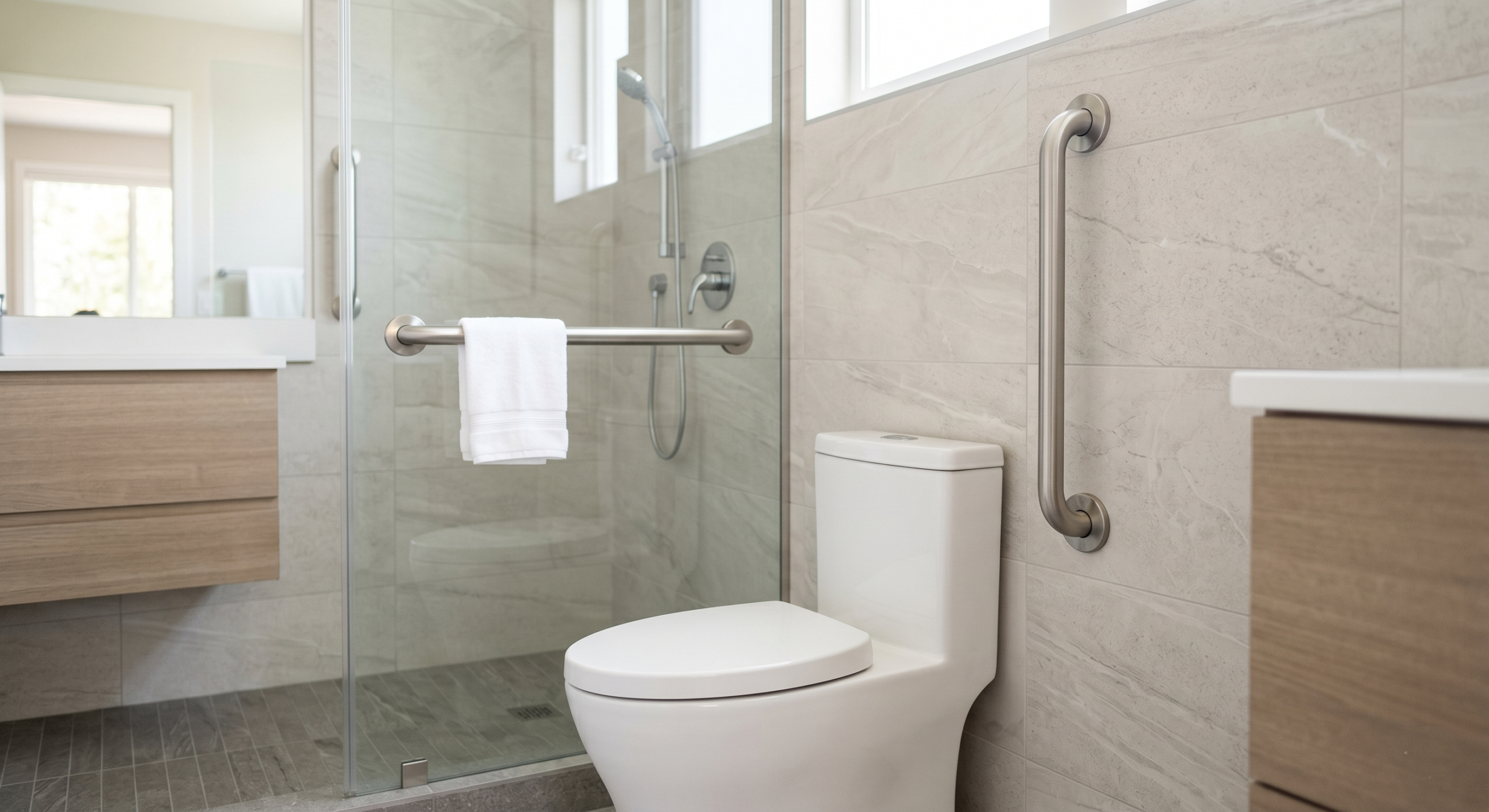
Quick Answer: The most important grab bar location around a toilet is a horizontal bar on the side wall at 33 to 36 inches from the floor, running parallel to the toilet seat. A second bar on the rear wall at the same height adds additional support. Both bars must be mounted into wall studs for safety. This guide covers exact placement measurements for every bathroom configuration.
Grab bars around the toilet are one of the most effective fall prevention measures available for seniors. The bathroom is the most dangerous room in the home for elderly individuals, and the area around the toilet is where many serious falls occur — when sitting down, standing up, or adjusting position.
This complete guide covers exactly where to place grab bars around the toilet, what types to use, and how to install them correctly for maximum safety.
Seniors most often need grab bar support near the toilet, inside the shower or bathtub, along bathroom walls used for balance, and near entry and exit points.
A Note From Margaret Collins
Of all the home safety modifications I recommend, grab bars around the toilet have the single highest impact on preventing serious falls. The toilet area is where seniors are most vulnerable — sitting and standing from a low surface requires significant leg strength and balance that declines with age. I have recommended grab bar installation to hundreds of families, and the feedback is always the same: they wish they had done it sooner. Correct placement is everything — a bar in the wrong position provides false security.
Why Grab Bars Around the Toilet Are Essential
Sitting down onto a toilet and standing back up requires significant leg strength and balance. For seniors with weakened muscles, joint pain, or balance issues, this simple daily action becomes a genuine fall risk.
Without support, seniors often:
- Lower themselves quickly and lose control
- Grab onto towel rails that pull away from the wall
- Lean on the toilet tank which can crack or tip
- Fall sideways when standing due to dizziness or weakness
A properly installed grab bar gives the senior something solid and reliable to hold, making the entire process significantly safer.
The Most Important Rule About Grab Bars
Before anything else, understand this: grab bars must be mounted into wall studs or with specialist hollow wall anchors rated for the load. A grab bar screwed only into drywall will pull straight out of the wall when weight is applied, causing a fall worse than having no bar at all.
If you are not confident about finding studs and mounting securely, hire a handyman or contractor. The cost is small compared to the cost of a fall.
Where to Place Grab Bars Around the Toilet
There are three key positions for grab bars around the toilet. The best setup uses at least two of these positions together.
Position 1 — Side Wall Bar (Most Important)
A horizontal grab bar on the side wall next to the toilet is the single most important grab bar placement for toilet safety.
Placement specifications:
- Mount on the wall beside the toilet, on the dominant hand side of the senior if possible
- Height: 33 to 36 inches from the floor
- The bar should run parallel to the floor
- Length: 36 to 42 inches is ideal
- Position the bar so it extends from behind the toilet to in front of the toilet seat
How it helps: The senior grabs this bar with one hand to control their descent when sitting and to push themselves up when standing. It provides direct lateral support at exactly the right moment.
Recommended option: The Moen Home Care 42-Inch Grab Bar is one of the most commonly installed toilet-area grab bars, with a 500 lb weight capacity and available in chrome, brushed nickel, and white finishes to match any bathroom.
Position 2 — Rear Wall Bar
A horizontal bar mounted on the wall behind the toilet provides additional support and helps the senior reposition while seated.
Placement specifications:
- Mount on the wall directly behind the toilet
- Height: 33 to 36 inches from the floor
- Length: 24 to 36 inches
- Centre the bar on the toilet
How it helps: The senior can reach back to this bar when adjusting position or preparing to stand. It also helps seniors who need support on both sides.
Position 3 — Flip-Down or Swing-Away Bar
For toilets that are not against a side wall, a floor-mounted or wall-mounted flip-down bar is the solution. These bars fold flat against the wall when not in use and swing into position beside the toilet when needed.
Placement specifications:
- Mount so the bar sits 33 to 36 inches from the floor when in the down position
- Position alongside the toilet on whichever side the senior finds most comfortable
- Ensure the bar extends far enough forward to be gripped while standing
How it helps: Provides side support in bathrooms where a standard side wall bar is not possible due to layout. Also useful in shared bathrooms where other users prefer not to have permanent bars in the way.
Recommended option: The Carex Toilet Safety Rail is a practical option for bathrooms without a suitable side wall, providing armrests on both sides without requiring wall mounting — ideal for renters or temporary installations.
Grab Bar Placement in the Shower or Bathtub
In showers and bathtubs, grab bars help seniors keep their balance on wet surfaces. Placement should support stepping in and out as well as standing while bathing. Vertical bars assist with stepping over the tub wall, while horizontal bars provide support while standing — many bathrooms benefit from both.
Standard Grab Bar Heights for Toilet Area
The standard height range for toilet grab bars is 33 to 36 inches from the floor. This range accommodates most seniors comfortably, but individual height and mobility should be considered.
For taller seniors — mount bars at the higher end of the range, around 36 inches. For shorter seniors — mount bars at the lower end, around 33 inches.
The best way to determine the correct height is to have the senior sit on the toilet and reach naturally for where they would want to grip. Mark that height and mount accordingly.
Grab Bar Length Recommendations
Side wall bar: 36 to 42 inches. Longer bars give more grip options and accommodate different positions during sitting and standing.
Rear wall bar: 24 to 36 inches. This bar does not need to be as long as the side bar.
A longer bar is generally better than a shorter one because it gives the senior more flexibility in where they grip.
Types of Grab Bars for Toilet Areas
Standard straight bar — The most common type. Simple, reliable, and available in many lengths and finishes. Suitable for most toilet grab bar installations.
Angled bar — Installed at a diagonal angle. Useful for seniors who find it easier to grip a bar that transitions from vertical to horizontal, helping both the sitting and standing phases.
Flip-down bar — Hinges flat against the wall when not in use. Ideal for bathrooms where a permanent side bar is not possible.
Floor-mounted safety rail — A freestanding frame that fits around the toilet and requires no wall mounting. Suitable for renters or situations where wall mounting is not possible. Less stable than wall-mounted bars but better than no support.
Toilet safety frame — Fits directly onto the toilet itself. Provides armrests on both sides. Easy to install without tools. Less stable than wall-mounted grab bars but a useful option for immediate installation.
Material and Finish
Grab bars must be made from materials strong enough to support full body weight. Recommended materials:
Stainless steel — Most durable and resistant to bathroom moisture. Recommended for long-term installation.
Chrome plated steel — Strong and affordable. Standard choice for most bathroom grab bar installations.
Avoid plastic grab bars — Plastic bars are not strong enough for fall prevention use. They are decorative only.
Finish considerations: Textured or matte finishes provide better grip than smooth polished finishes, especially with wet hands.
How to Install Grab Bars Correctly
Installation into wall studs is the gold standard. Here is the correct process:
Find the studs — Use a stud finder to locate wall studs. Standard stud spacing is 16 inches apart.
Mark the position — Hold the bar at the correct height and mark the mounting holes.
Pre-drill — Drill pilot holes slightly smaller than the mounting screws.
Mount the bar — Use screws long enough to penetrate at least 1.5 inches into the stud.
Test the installation — After mounting, apply firm downward and outward pressure to the bar. It should not move at all.
If studs are not in the right position — Use specialist toggle bolts rated for the required load. Standard drywall anchors are not sufficient for grab bars.
Common Grab Bar Installation Mistakes
Mounting into drywall only — This is dangerous. The bar will pull out under load. Always mount into studs or use load-rated anchors.
Installing too low or too high — Bars at the wrong height force the senior to reach awkwardly, reducing effectiveness.
Bar too short — A short bar limits grip options and may not reach far enough forward for the standing phase.
Using towel rails as grab bars — Towel rails are not designed for body weight. They will fail.
Not testing after installation — Always test with firm pressure before trusting the bar with a senior’s safety.
Additional Toilet Safety Measures
Grab bars work best as part of a complete toilet safety setup:
Raised toilet seat — Reduces the distance the senior must lower and raise themselves. Significant reduction in fall risk.
Toilet safety frame — Provides armrests on both sides for seniors who need support from both sides simultaneously.
Non-slip floor mat — Place a non-slip mat on the floor in front of the toilet to prevent slipping when standing.
Adequate lighting — Ensure the bathroom is well lit, especially at night. A motion-sensor night light removes the need to find a switch in the dark.
Frequently Asked Questions
Where is the best place to put a grab bar next to a toilet? The most important position is on the side wall next to the toilet, mounted at 33 to 36 inches from the floor. This bar should run parallel to the floor and extend from behind the toilet to in front of the seat.
How high should grab bars be around a toilet? The standard height is 33 to 36 inches from the floor. Adjust within this range based on the senior’s height and comfort.
Can grab bars be installed without finding studs? Yes, but only using specialist toggle bolts or anchors specifically rated for the load. Standard drywall anchors are not safe for grab bars.
How much weight must a grab bar support? Grab bars should be installed to support a minimum of 250 lbs of force in any direction. Quality grab bars and correct installation easily exceed this standard.
Are suction cup grab bars safe for seniors? No. Suction cup grab bars are not reliable enough for fall prevention use. They can release without warning. Only use permanently mounted grab bars for safety purposes.
What is the difference between a grab bar and a towel rail? A grab bar is specifically engineered to support body weight and is mounted into structural supports. A towel rail is decorative only and will fail if used for support. Never use a towel rail as a grab bar.
According to the American Journal of Preventive Medicine, installing grab bars in the bathroom reduces bathroom fall risk by up to 60%, making them one of the most evidence-backed home safety investments available for seniors.
Conclusion
Properly placed and correctly installed grab bars around the toilet can dramatically reduce fall risk for seniors during one of the most vulnerable daily activities. The side wall bar is the most important installation, followed by a rear wall bar or flip-down bar depending on the bathroom layout.
Always mount into wall studs, test every installation firmly before use, and combine grab bars with other toilet safety measures for maximum protection. A small investment in proper grab bar installation can prevent a serious, life-changing fall.