
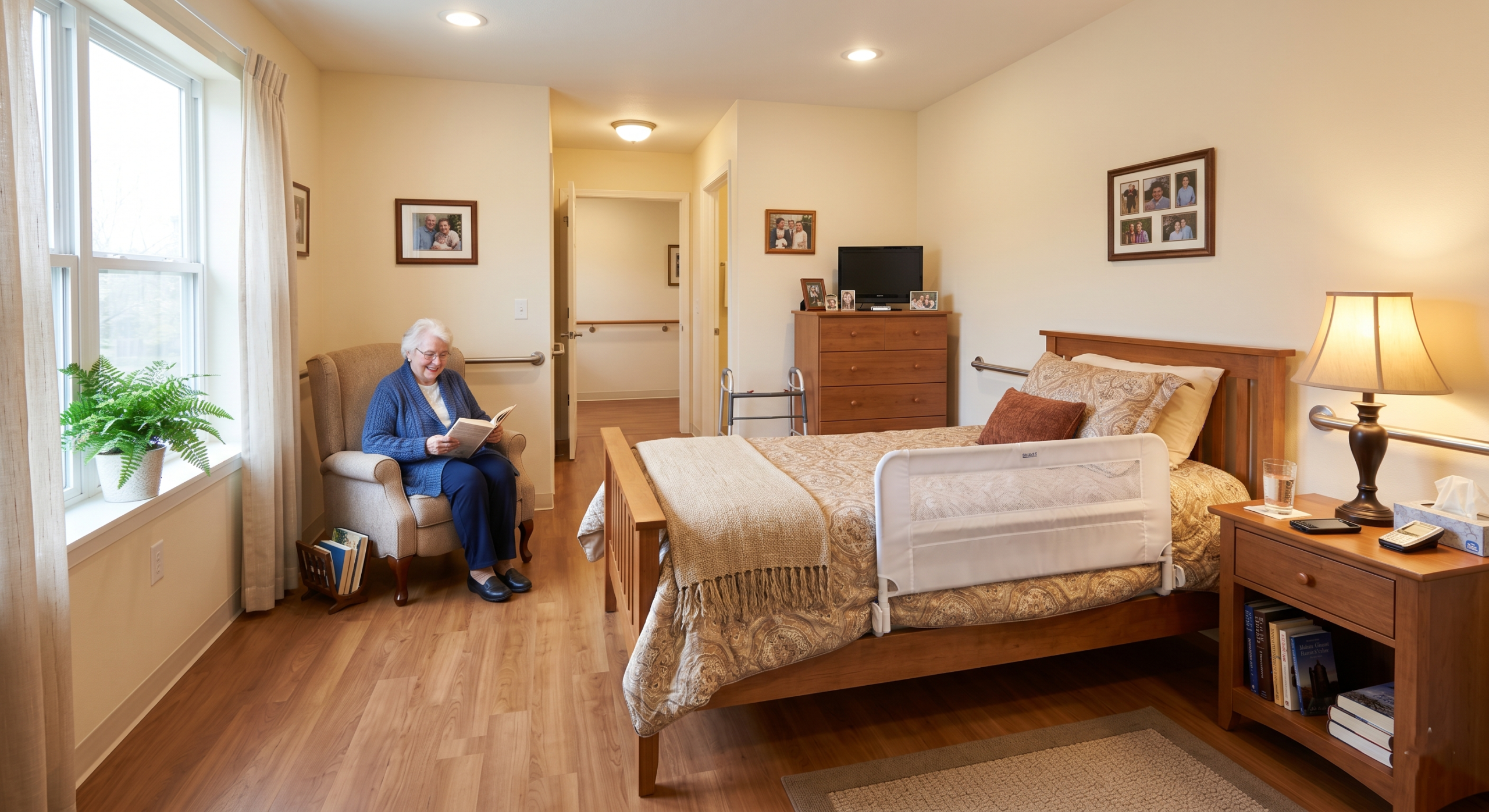
The bedroom is one of the most dangerous rooms in a senior home. Most bedroom falls happen at night — during the transition from lying down to standing, during trips to the bathroom in the dark, or when reaching for something near the bed. The good news is that bedroom falls are among the most preventable with the right modifications.
This complete guide covers every bedroom safety improvement for seniors, from bed height to lighting to flooring.
A Note From Margaret Collins
In my years working with senior families, I have found that bedroom safety is consistently the most overlooked area of home modification. Families focus on the bathroom — which is correct — but then assume the bedroom is fine. In reality, the bedroom is where many seniors spend their most vulnerable moments: waking from deep sleep, moving in darkness, and transitioning between lying and standing when muscles are cold and balance is at its lowest. This guide covers every modification I recommend to families during a home safety assessment.
Why Bedroom Safety Matters for Seniors
Falls that happen in the bedroom tend to be more serious than daytime falls because they often occur at night when the senior is disoriented from sleep, the room is dark, muscles are stiff from lying still, and no one else is nearby to help.
According to the World Health Organization, falls are the second leading cause of accidental injury deaths worldwide, with adults over 65 suffering the greatest number of fatal falls. A significant proportion of these falls occur in the bedroom during nighttime bathroom trips.
Bed Height — The Most Critical Bedroom Safety Factor
Incorrect bed height is the single most common bedroom safety problem I find during home assessments. A bed that is too low requires the senior to bend deeply to sit and significant effort to stand. A bed that is too high creates a fall risk when getting on and off.
Correct bed height for seniors:
The senior should be able to sit on the edge of the bed with their feet flat on the floor and their knees at approximately 90 degrees. This position allows them to stand up using leg strength with minimal strain.
If the bed is too low:
- Add a bed riser under each leg to increase height
- Replace the mattress with a thicker model
- Add a mattress topper
Recommended option: The Vive Bed Risers are heavy-duty risers available in multiple heights, supporting up to 1,200 lbs per set, and are compatible with most standard bed frames.
If the bed is too high:
- Remove the bed frame and place the mattress directly on a low platform
- Replace with a lower bed frame
Bed Rails and Safety Handles
A bedside grab bar or safety rail gives the senior something firm to hold when moving from lying to sitting and from sitting to standing. This single modification reduces the risk of a bedroom fall significantly.
Types of bed safety rails:
Bed safety handle — A handle that slots between the mattress and box spring or attaches to the bed frame. Provides a firm grip point at bed height.
Half-length bed rail — A rail that runs along the upper half of the bed. Helps with repositioning during the night and provides support when sitting up.
Floor-to-bed grab bar — A floor-mounted pole that provides a vertical grab bar from floor to ceiling next to the bed. No wall mounting required.
Recommended option: The Stander EZ Adjust Bed Rail is one of the most widely used bedside safety rails, fitting most standard mattress and box spring combinations with no tools required and supporting up to 300 lbs.
Bedroom Lighting — Eliminating the Darkness Risk
Most bedroom falls during nighttime bathroom trips happen in complete darkness. The senior wakes from deep sleep, stands up before their eyes have adjusted, and falls before they have taken three steps.
Night lighting essentials for the bedroom:
Bedside night light — A plug-in or battery-powered light within arm’s reach of the bed. The senior can activate it before standing.
Motion-activated path lighting — Lights that activate automatically when the senior gets out of bed. Place them along the floor between the bedroom door and the bathroom.
Motion-activated bathroom light — A light that turns on automatically when the senior enters the bathroom at night.
Recommended option: The Amerelle Motion Activated LED Night Light activates automatically when movement is detected and provides warm white light that does not cause disorientation. Place one in the bedroom and one in the hallway outside the bathroom.
Practical tip: The light switch for the bedroom should be within arm’s reach from the bed. If it is not, add a remote-controlled lamp or a smart plug that can be controlled from the bedside.
Bedroom Flooring Safety
The bedroom floor between the bed and the bathroom door is the highest-risk walking surface in the senior’s daily routine.
Key flooring safety rules:
Remove all loose rugs — Loose rugs are the single most common trip hazard in senior bedrooms. Remove them entirely rather than using non-slip backing, which can still shift over time.
Secure all carpet edges — Raised carpet edges and loose carpet corners are serious trip hazards. Secure with carpet tape or tack strips.
Clear the pathway — The direct path from the bed to the bedroom door and bathroom must be completely clear of furniture, clothing, shoes, and any other obstacles at all times.
Non-slip socks or slippers — The senior should have non-slip footwear within reach of the bed. Walking in socks on smooth floors is a significant slip risk.
Furniture Placement and Bedroom Layout
The layout of bedroom furniture directly affects fall risk.
Key furniture placement rules:
Nightstand within reach — The nightstand should be within easy arm’s reach from the lying position. The senior should not have to lean or stretch to reach their phone, glasses, or medication.
Clear turning space — There should be at least 36 inches of clear space on the side of the bed the senior uses most. This allows them to stand and turn without being obstructed by furniture.
Stable furniture only — Any furniture the senior might reach for when getting up must be completely stable. Lightweight chairs, small tables, and furniture on wheels are fall hazards if grabbed for support.
Remove unnecessary furniture — Excess furniture creates obstacles and reduces safe movement space. A bedroom with a clear, simple layout is significantly safer than one crowded with furniture.
Bedroom Door and Threshold Safety
Door threshold strips — Raised door thresholds are trip hazards. Replace raised thresholds with flush threshold strips or add a beveled transition strip to eliminate the raised edge.
Door width — If the senior uses a walker or wheelchair, check that all bedroom doorways are at least 32 inches wide. Standard walkers require 24 to 28 inches. Rollators require 28 to 32 inches.
Door handles — Replace round doorknobs with lever-style handles throughout the bedroom and bathroom. Lever handles are significantly easier to operate for seniors with arthritis or weak grip.
Phone and Emergency Access
A senior who falls in the bedroom at night and cannot get up needs to be able to call for help from floor level.
Essential emergency access measures:
Phone within reach of the bed — The senior’s phone must be on the nightstand, not charging across the room. A fall from bed can leave the senior unable to reach a phone on a dresser.
Medical alert device — A wearable medical alert button is the single most important safety device for seniors living alone. It must be worn at all times — including at night — not just kept near the bed.
Recommended practice: Establish a daily check-in routine with a family member or neighbor. A simple text or phone call each morning confirms the senior is safe.
Bedroom Temperature and Comfort
Cold bedroom temperatures cause seniors to rush their movements — getting up quickly to escape the cold rather than moving slowly and carefully.
Temperature recommendations:
- Bedroom temperature should be maintained between 65 and 70 degrees Fahrenheit at night
- Extra blankets within reach allow the senior to stay warm without rushing to get up
- Dressing gown or warm layer within easy reach of the bed reduces the urgency of getting up quickly in a cold room
Bedroom Safety Checklist
Use this checklist to assess a senior’s bedroom:
Bed and bedside:
- ✅ Bed height allows feet flat on floor when seated
- ✅ Bed rail or safety handle installed
- ✅ Nightstand within easy arm’s reach
- ✅ Phone on nightstand at all times
- ✅ Non-slip footwear within reach of bed
- ✅ Medical alert device worn or within reach
Lighting:
- ✅ Night light within arm’s reach of bed
- ✅ Motion-activated path lighting to bathroom
- ✅ Light switch reachable from bed without standing
Flooring and pathways:
- ✅ All loose rugs removed
- ✅ All carpet edges secured
- ✅ Clear pathway from bed to door and bathroom
- ✅ No obstacles or clutter on bedroom floor
Furniture and layout:
- ✅ Minimum 36 inches clear space beside bed
- ✅ All furniture is stable and will not tip if grabbed
- ✅ Unnecessary furniture removed
Doors and access:
- ✅ Door threshold is flush or beveled
- ✅ Door handles are lever style
- ✅ Doorway wide enough for mobility aid if used
Frequently Asked Questions
What is the safest bed height for seniors? The safest bed height allows the senior to sit on the edge with their feet flat on the floor and knees at approximately 90 degrees. This is typically between 20 and 23 inches from the floor to the top of the mattress for most adults.
Should seniors use bed rails? Yes, in most cases. A bedside safety handle or half-length bed rail provides a firm grip point that significantly reduces the risk of falls during the sitting-up and standing phase. Full-length bed rails are not recommended as they can create an entrapment hazard.
Are loose rugs safe in a senior bedroom? No. Loose rugs are one of the most common trip hazards in senior bedrooms and should be removed entirely. Non-slip backing reduces but does not eliminate the risk. Removal is the safest solution.
What lighting is best for seniors at night? Motion-activated LED night lights placed along the path from bed to bathroom are the safest option. They activate automatically when the senior gets up, eliminating the need to find a switch in the dark.
How can I make a bedroom safer for a senior living alone? The highest priority modifications for a senior living alone are a bedside safety rail, motion-activated path lighting to the bathroom, a phone on the nightstand, a wearable medical alert device, removal of all loose rugs, and a daily check-in routine with a family member or neighbor.
Conclusion
Bedroom safety for seniors requires attention to bed height, bedside support, lighting, flooring, furniture layout, and emergency access. Each of these factors contributes to the most dangerous moment of a senior’s daily routine — the nighttime transition from bed to bathroom and back.
The modifications in this guide are practical, affordable, and genuinely effective. Implementing them systematically — starting with bed height, bedside support, and lighting — creates a bedroom environment where a senior can move safely and confidently throughout the night.
1 thought on “Bedroom Safety for Seniors: Complete Guide to Preventing Nighttime Falls”
Comments are closed.