
Paste this full content now:
A bathroom renovation for senior safety does not have to cost thousands of dollars. The most impactful changes — the ones that genuinely prevent falls and improve daily independence — are often the most affordable. This guide covers practical, budget-friendly bathroom renovation ideas specifically designed for senior safety, from quick fixes under $50 to moderate renovations under $500.
A Note From Margaret Collins
The most important lesson I have learned from conducting home safety assessments is that the most expensive renovation is rarely the most effective one. I have seen families spend thousands on complete bathroom remodels when a $30 grab bar and a $15 non-slip mat would have addressed the actual risk. This guide focuses on maximum safety impact for minimum cost — the changes that make the biggest real-world difference for seniors living at home.
Why Bathroom Safety Renovation Matters
The bathroom is the most dangerous room in a senior home. The combination of wet surfaces, smooth floors, physically demanding transitions — sitting, standing, stepping over tub edges — and privacy that means falls often happen when no one is nearby creates a uniquely high-risk environment.
According to the CDC, approximately 80% of serious senior falls occur in the bathroom. Targeted bathroom modifications directly address this risk at a fraction of the cost of general home renovation.
Budget Level 1 — Under $50: Immediate Safety Improvements
These changes require no professional installation and can be completed in an afternoon.
1. Non-Slip Bath Mat — $15 to $30
A non-slip bath mat inside the shower or tub is one of the highest-impact changes available at the lowest cost.
What to look for:
- Strong suction cups that grip the tub or shower floor firmly
- Full coverage of the shower floor rather than a small central mat
- Textured surface for wet grip
- Easy to remove and clean
Recommended option: The Vive Non-Slip Bath Mat uses industrial-strength suction cups and covers the full shower floor area. It is one of the most widely used shower safety mats in senior homes.
2. Non-Slip Mat Outside the Shower — $15 to $25
The floor immediately outside the shower is one of the highest-risk spots in the bathroom. Water drips from the senior as they step out, creating a wet slippery surface at exactly the moment they are stepping over the shower threshold.
A non-slip mat outside the shower absorbs water and provides grip at this critical transition point.
3. Toilet Safety Frame — $30 to $50
A toilet safety frame is a freestanding metal frame that fits around the toilet, providing armrests on both sides for sitting down and standing up. It requires no wall mounting and no tools.
This is the fastest and most affordable way to add toilet support without installing permanent wall-mounted grab bars.
Recommended option: The Carex Toilet Safety Rail provides armrests on both sides of the toilet, supports up to 250 lbs, and installs in minutes without tools. It is ideal for renters or situations where wall mounting is not possible.
4. Raised Toilet Seat — $25 to $50
A raised toilet seat fits over the existing toilet and raises the seated height by 2 to 5 inches. This reduces the depth the senior must lower themselves and the effort required to stand back up.
Recommended option: The Vive Raised Toilet Seat raises the toilet height by 5 inches and includes armrests on both sides for additional support when sitting and standing. No tools required for installation.
5. Grab Bar for Shower Entry — $20 to $40
A tension-mounted grab bar fits between the floor and ceiling of the shower entry area without any drilling or wall mounting. While not as strong as a permanently mounted bar, it provides useful support for relatively stable seniors during shower entry and exit.
Important note: Tension-mounted bars are not appropriate for seniors who need to bear significant weight on the bar. For full weight-bearing support, a permanently mounted grab bar is required.
Budget Level 2 — $50 to $200: Moderate Safety Improvements
These changes provide stronger and more permanent safety benefits. Most can be completed as DIY projects.
6. Permanently Mounted Grab Bars — $30 to $80 per bar
Permanently mounted grab bars are the single most impactful bathroom safety modification available. A grab bar correctly installed into wall studs next to the toilet and inside the shower provides reliable support for full body weight.
Priority locations:
- Side wall next to toilet at 33 to 36 inches from the floor
- Inside shower on the side wall at 33 to 36 inches
- Vertical bar at the shower entry point
Recommended option: The Moen Home Care Grab Bar is available in multiple lengths from 16 to 42 inches, supports up to 500 lbs when correctly installed, and is available in chrome, brushed nickel, and white finishes to match existing bathroom fixtures.
Installation note: Always mount into wall studs. Use a stud finder before drilling. If studs are not in the right position, use toggle bolts rated for grab bar use. Standard drywall anchors are never sufficient.
7. Handheld Shower Head — $30 to $80
Replacing a fixed shower head with a handheld model on a flexible hose transforms shower safety for seniors. The senior can direct water precisely, wash while seated on a shower chair, and avoid the need to turn and reach under a fixed spray.
What to look for:
- Hose length of at least 60 inches
- Adjustable spray settings
- Pause button to reduce water use
- Compatible with existing shower arm
Recommended option: The Moen Engage Magnetix Handheld Shower Head includes a magnetic docking system that makes replacing the head on the holder easy with one hand — particularly useful for seniors with limited grip strength.
8. Shower Chair or Bench — $40 to $100
A shower chair or bench allows the senior to shower while seated, eliminating the need to stand for the full duration of the shower. This is one of the most significant safety improvements for seniors with limited stamina, balance issues, or leg weakness.
Types:
- Shower chair — A four-legged chair that sits inside the shower. Lightweight and portable.
- Transfer bench — A bench that extends outside the shower. The senior sits on the outside portion and slides across into the shower without stepping over the threshold. Ideal for seniors with significant mobility limitations.
Recommended option: The Drive Medical Shower Chair with Back and Arms is one of the most widely used shower chairs in senior care, featuring a non-slip seat, adjustable height, and 300 lb weight capacity.
9. Anti-Scald Valve or Thermostatic Mixer — $50 to $150
Seniors with reduced sensation or slower reaction times are at risk of scalding from sudden hot water. An anti-scald valve or thermostatic mixer limits the maximum water temperature to a safe level.
Recommended setting: Maximum water temperature of 120°F (49°C) at the tap. This is warm enough for comfortable showering while eliminating scalding risk.
This modification typically requires a plumber for installation but is one of the most important safety improvements for seniors who shower independently.
Budget Level 3 — $200 to $500: High-Impact Permanent Modifications
These modifications require professional installation but provide the strongest long-term safety benefits.
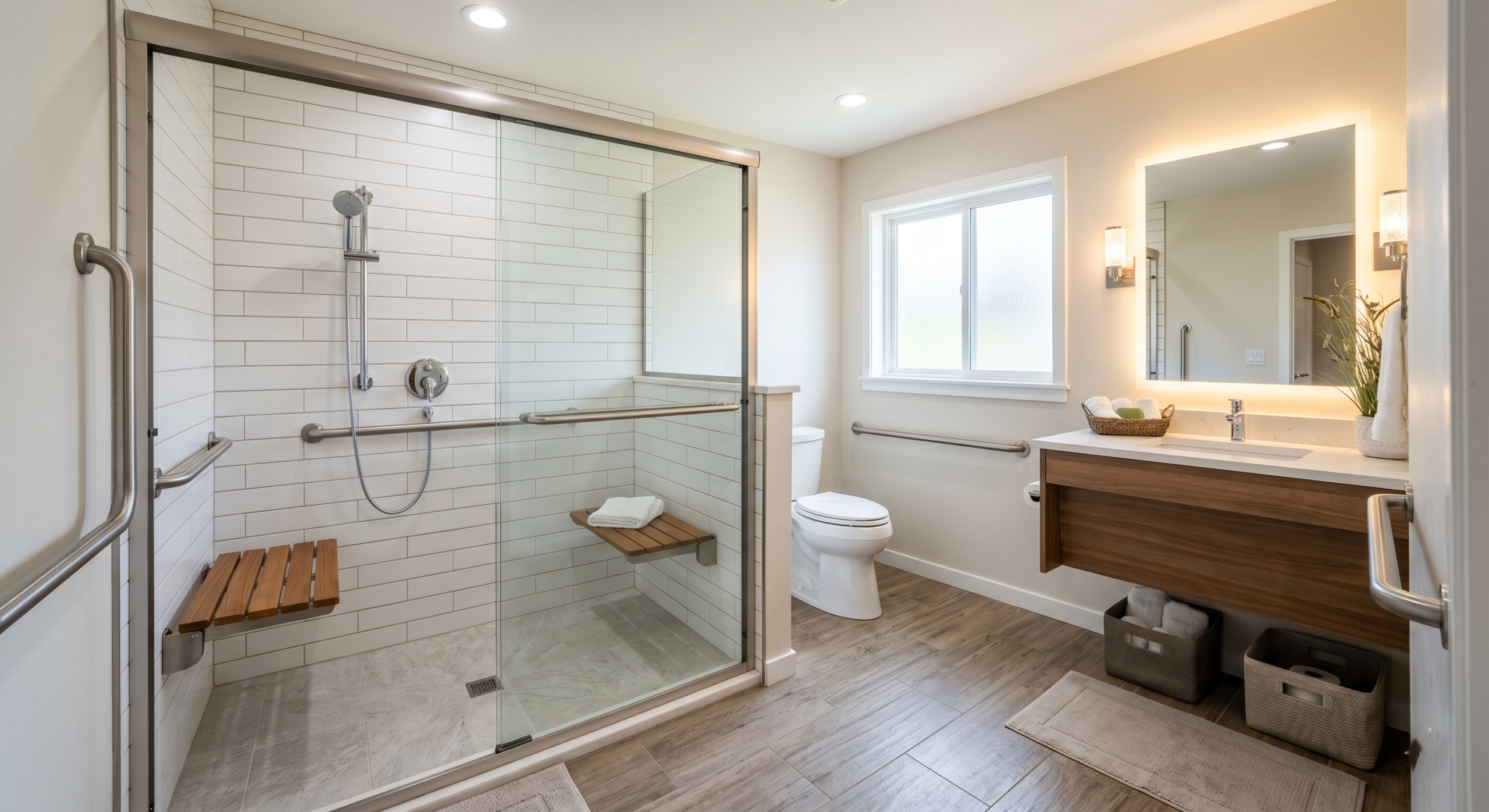
10. Walk-In Shower Conversion — $300 to $500+
The single most impactful bathroom modification for seniors with significant mobility limitations is converting a standard tub-shower combination into a walk-in shower with a low or zero-threshold entry.
Stepping over a bathtub edge is one of the highest-risk movements in the senior bathroom. Eliminating the step-over entirely removes this risk completely.
Key features of a safe walk-in shower:
- Zero or low threshold entry (maximum 0.5 inches)
- Textured non-slip floor surface
- Built-in shower seat or fold-down seat
- Grab bars on two walls
- Handheld shower head
- Wide entry for walker or wheelchair access
Cost note: A basic tub-to-shower conversion can be completed for $300 to $500 with a contractor. Full tile walk-in shower installations cost more but can often be staged over time.
11. Comfort Height Toilet — $150 to $300
A comfort height toilet — also called an ADA toilet — is taller than a standard toilet, with a seat height of 17 to 19 inches compared to the standard 15 inches. This height is significantly easier for seniors to sit down onto and stand up from.
If a full toilet replacement is not practical, a raised toilet seat achieves a similar result at much lower cost.
12. Improved Bathroom Lighting — $50 to $200
Bright, even lighting throughout the bathroom eliminates the shadows and dim areas that make it difficult for seniors with reduced vision to judge surfaces, step edges, and water on the floor.
Lighting priorities:
- Overall ceiling light that eliminates shadows
- Vanity lighting that illuminates the face clearly for medication management
- Night light that activates automatically for nighttime bathroom visits
Recommended option: Motion-activated LED ceiling lights are the most practical solution for senior bathrooms, ensuring full illumination activates automatically without requiring the senior to find a switch on entering.
Renovation Priority Order
If budget is limited, complete modifications in this order of safety impact:
- Non-slip bath mat inside shower — immediate, under $30
- Non-slip mat outside shower — immediate, under $25
- Toilet safety frame or raised toilet seat — under $50
- Permanently mounted grab bar next to toilet — under $80
- Grab bar inside shower — under $80
- Handheld shower head — under $80
- Shower chair — under $100
- Walk-in shower conversion — when budget allows
Frequently Asked Questions
What is the most important bathroom modification for senior safety? Installing a permanently mounted grab bar next to the toilet is the single most impactful bathroom modification for senior safety. The toilet area is where the highest proportion of serious bathroom falls occur, and a correctly installed grab bar provides reliable support for the sitting and standing transitions that happen multiple times every day.
Can bathroom safety modifications be done without professional help? Yes. Non-slip mats, raised toilet seats, toilet safety frames, and tension-mounted grab bars require no professional installation. Permanently mounted grab bars can be a DIY project if the installer is comfortable with a drill and stud finder. Walk-in shower conversions and anti-scald valve installation require professional plumbers or contractors.
Is a walk-in shower safer than a bathtub for seniors? Yes. A walk-in shower with a zero or low threshold entry is significantly safer than a bathtub for seniors. Stepping over a bathtub edge is one of the highest-risk movements in the senior home. Eliminating the step-over removes this risk entirely.
How much does a senior bathroom renovation cost? Basic senior bathroom safety modifications — non-slip mats, grab bars, raised toilet seat, and shower chair — can be completed for under $200. A full walk-in shower conversion costs $300 to $500 or more depending on materials and labor.
Are grab bars covered by insurance or Medicare? In the United States, Medicare does not typically cover grab bars or bathroom safety modifications as they are considered home modifications rather than medical equipment. However, some Medicare Advantage plans, Medicaid programs, and veteran benefits programs do cover bathroom safety modifications. Check with your specific plan for coverage details.
Conclusion
A safer senior bathroom does not require a complete renovation or a large budget. The highest-impact changes — grab bars, non-slip mats, a raised toilet seat, and a shower chair — can be completed for under $200 and address the majority of serious bathroom fall risks.
Work through the priority order in this guide, starting with the lowest-cost highest-impact modifications and progressing to permanent structural changes as budget allows. Every modification completed reduces real fall risk for the senior using that bathroom every day.
2 thoughts on “Senior Bathroom Renovation Ideas on a Budget: Complete Guide”
Comments are closed.