
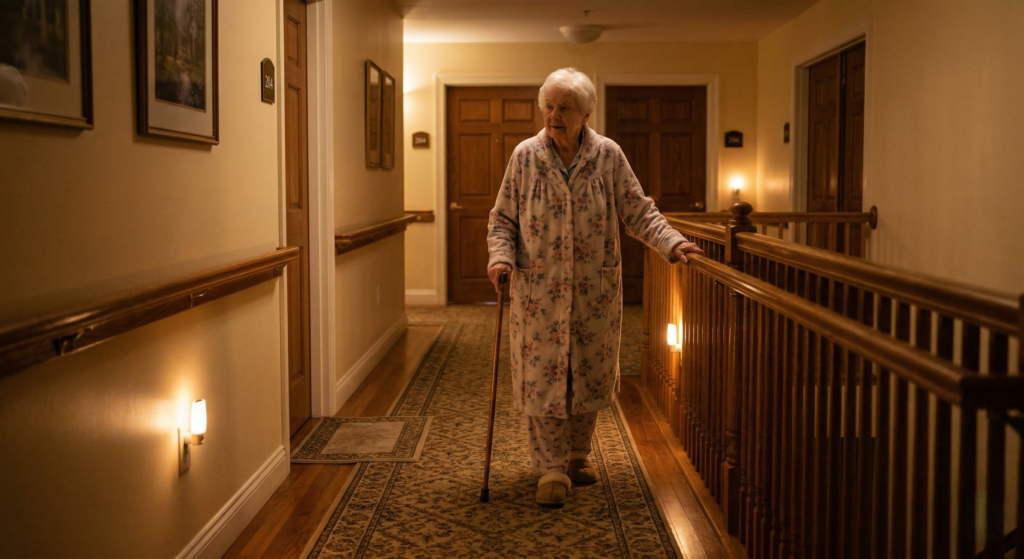
Quick Answer: The best night lights for seniors are motion-activated LED lights placed along the path from bedroom to bathroom. They turn on automatically in the dark without requiring the senior to find a switch. The National Institute on Aging reports that over half of all senior falls occur at night or in low-light conditions — making night lighting one of the highest impact and lowest cost fall prevention measures available.
Poor lighting at night is one of the most overlooked fall risks in senior homes. Many falls happen not because of major obstacles, but because a senior could not see clearly when getting up in the middle of the night. The right night lights, placed in the right locations, can dramatically reduce this risk.
This guide covers everything seniors and caregivers need to know about choosing and placing night lights for maximum safety.
A Note From Margaret Collins
The most heartbreaking falls I have encountered in my career happened at night — a senior getting up to use the bathroom in the dark, a single misstep, and a life changed permanently. In almost every case, a simple night light in the right location would have prevented it entirely. Night lighting is the lowest cost, highest impact home safety investment a family can make for a senior. I recommend it to every family I work with, without exception.
Why Night Lighting Matters So Much for Seniors
As people age, vision changes in ways that make low-light navigation significantly more dangerous:
- Eyes take longer to adjust from light to darkness
- Depth perception becomes less accurate in dim conditions
- Contrast sensitivity decreases, making it harder to see edges and steps
- Pupils become smaller, allowing less light into the eye
These changes mean that a hallway that feels adequately lit to a younger person may be genuinely dangerous for a senior. A small investment in proper night lighting can prevent a serious, life-changing fall.
Do Seniors Need Night Lights in Every Room?
Not every room needs a night light, but every room a senior passes through at night does. The key is to think about the path a senior takes when they get up during the night — typically from the bedroom to the bathroom — and ensure that entire path is clearly lit.
High priority areas that must have night lighting:
- Bedroom — near the bed so the senior can see immediately upon waking
- Hallway — the full length of any hallway between bedroom and bathroom
- Bathroom — so the senior can see clearly upon entering
- Staircase — if the senior must use stairs during the night
Lower priority areas that benefit from night lighting:
- Kitchen — if the senior visits during the night
- Living room — if it is part of the nighttime path
The 3 Main Types of Night Lights for Seniors
1. Plug-In Night Lights
Plug-in night lights are the simplest and most affordable option. They plug directly into a wall outlet and provide constant low-level illumination throughout the night.
Best for: Hallways, bathrooms, and any room where consistent background lighting is needed.
Look for: Models with a dusk-to-dawn sensor that turn on automatically when it gets dark and off when daylight returns. This removes the need for the senior to remember to switch them on.
Recommended option: The GE Ultrabrite LED Night Light with dusk-to-dawn sensor is one of the best-selling plug-in options, turning on automatically at night and using less than 0.5 watts of energy.
2. Motion Sensor Night Lights
Motion sensor night lights activate automatically when movement is detected and turn off after a set period of inactivity. They are ideal for seniors because they require no interaction — the light simply comes on when the senior gets up.
Best for: Bedrooms, hallways, and bathrooms where hands-free operation is most important.
Benefits for seniors:
- No need to find a switch in the dark
- Eliminates sudden movement to reach for lights
- Saves energy by only activating when needed
- Provides immediate bright light exactly when needed
Recommended option: The Amerelle Motion Activated LED Night Light automatically activates when movement is detected and is widely used in senior homes for its reliability and warm light output.
3. Rechargeable and Portable Night Lights
Rechargeable night lights can be placed anywhere in the home without needing a nearby outlet. Some models also function as torches, which is useful during power cuts.
Best for: Bedrooms where outlets are not near the bed, or as a backup light source.
Where to Place Night Lights for Maximum Safety
Placement is just as important as having night lights at all. Here is exactly where to place them:
Bedroom — Place one night light on each side of the bed if possible. At minimum, place one on the side the senior gets out from. The light should illuminate the floor between the bed and the door.
Hallway — Place night lights every 6 to 8 feet along the hallway. There should be no dark patches between the bedroom and bathroom. If the hallway is short, one centrally placed light may be sufficient.
Bathroom — Place a night light near the floor on the wall opposite the door so it is visible immediately upon entering. A second light near the toilet is also helpful.
Staircase — Place lights at both the top and bottom of the stairs. If the staircase is long, add lights along the wall at mid-stair level. The goal is to make every step clearly visible.
Kitchen — If the senior visits the kitchen at night, place a night light near the entrance and one near the kettle or water source.
Features to Look for When Choosing Night Lights for Seniors
Not all night lights are equal. These features make the most difference for senior safety:
Automatic activation — Look for dusk-to-dawn sensors or motion sensors. Manual night lights are less reliable because they depend on remembering to switch them on.
Warm light colour — Warm white light (2700K to 3000K) is easier on older eyes than cool white or blue-tinted light. It also causes less disruption to sleep patterns.
Adequate brightness — The light should be bright enough to see the floor and any obstacles clearly, but not so bright that it disrupts sleep. Most plug-in night lights between 0.5 and 3 watts are appropriate.
Low heat output — LED night lights produce very little heat and are safe to leave on continuously. Avoid older bulb types that generate significant heat.
Non-glare design — Lights that shine directly into the eyes can cause discomfort and temporarily reduce vision. Choose downward-facing or diffused light designs.
Are Motion Sensor Lights Good for Seniors?
Yes — motion sensor lights are particularly well suited to seniors for several reasons.
They activate the moment a senior gets out of bed, before they take their first step. This immediate illumination is exactly when lighting is most needed. There is no fumbling for a switch, no walking in the dark to reach a light source.
For seniors who wake frequently during the night, motion sensor lights also help preserve sleep quality. The light only comes on when movement is detected, so it does not continuously illuminate the room during sleep.
The only consideration is sensitivity. Some motion sensors may be triggered by a pet or by minor movements during sleep. Choose a model with adjustable sensitivity if this is a concern.
Combining Night Lights with Other Safety Measures
Night lights work best as part of a broader home safety approach. For maximum fall prevention:
- Remove loose rugs from all nighttime pathways
- Keep the path between bedroom and bathroom completely clear of furniture and obstacles
- Install grab bars in the bathroom
- Use non-slip mats in the bathroom and shower
- Ensure the bed is at the correct height for easy entry and exit
How to Test Your Night Lighting
Once night lights are installed, test them properly:
Walk the full path from the bedroom to the bathroom at night with no other lights on. You should be able to see the floor clearly, identify any obstacles, and navigate safely without any uncertainty. If any section feels dark or unclear, add another light.
Ask the senior to do the same walk and give their own assessment. Their experience matters most.
Frequently Asked Questions
What type of night light is best for seniors? Motion sensor night lights are generally the best choice because they activate automatically without any action required from the senior. Plug-in dusk-to-dawn lights are also excellent for consistent background illumination.
How many night lights does a senior need? At minimum, one in the bedroom near the bed, one in the hallway, and one in the bathroom. Most senior homes benefit from four to six night lights placed along all nighttime pathways.
Are night lights safe to leave on all night? Yes. Modern LED night lights are designed to run continuously and are extremely energy efficient. They generate very little heat and are safe to leave on permanently.
What colour light is best for seniors at night? Warm white light in the range of 2700K to 3000K is best. It is easier on ageing eyes and causes less disruption to sleep than cool white or blue-tinted light.
Where should a night light be placed in a bedroom? Place the night light on the floor side of the bed where the senior gets out, pointing toward the door. This illuminates the floor immediately and the path toward the exit.
Can night lights prevent falls? Yes. Proper night lighting is one of the most effective and affordable fall prevention measures available. Most nighttime falls happen because the senior could not see clearly — lighting directly addresses this cause.
According to the National Institute on Aging, over half of all falls in seniors occur at night or in low-light conditions, making adequate night lighting one of the most effective and affordable fall prevention measures available.
Conclusion
Night lights are one of the simplest, most affordable, and most effective ways to improve safety for seniors at home. The right lights in the right locations can mean the difference between a safe trip to the bathroom and a serious fall.
Start with the bedroom, hallway, and bathroom. Choose motion sensor or dusk-to-dawn models for reliability. Test the full nighttime path yourself to confirm every section is adequately lit. These small steps can have a genuinely significant impact on senior safety and independence.
4 thoughts on “Best Night Lights for Seniors to Prevent Falls”
Comments are closed.